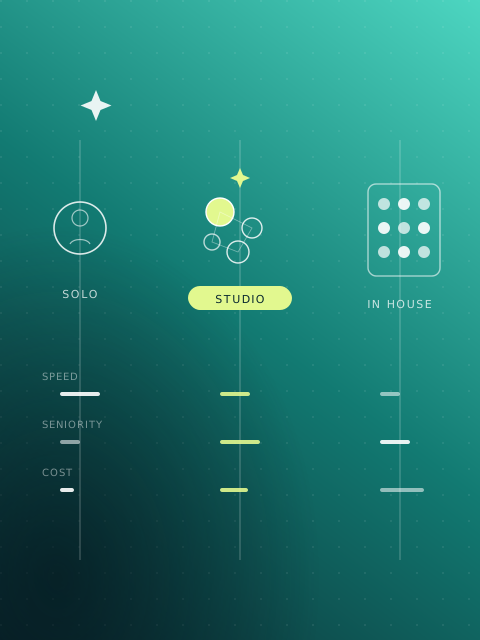
Design studio, freelancer or in house designer? What each is best for, how cost and speed compare, and why founders choose a studio for high stakes work.
The right shape of design team depends on three things: how strategic the problem is, how long you need the capability for, and how quickly you need to move. A freelancer suits a narrow task with a clear deliverable. A studio wins for strategic problems that need senior thinking across disciplines. An in house hire makes sense once design is a permanent, full time function.
For most founders building a product or a brand, the problem is strategic and the timeline is tight. That is exactly where a studio earns its fee.
When a freelancer fits
Freelancers suit narrow, well defined problems with a clear deliverable: a single landing page, a quick logo refresh, or overflow support for an existing in house team.
The limit is breadth. Most freelancers specialise in one discipline. If your problem needs strategy, product design, brand and development pulling in the same direction, you end up hiring and coordinating three or four freelancers yourself. That coordination is unpaid work, and it is harder than founders expect.
A freelancer solves a task. A studio solves a problem.
If you like the flexibility of a freelancer but need more than one pair of hands, a studio day rate gives you the same flexibility with a senior team behind it.
When to hire a design studio
Studios are the right choice when the problem is strategic, the deliverables span disciplines, and the outcome matters commercially. Product launches, rebrands, new markets, category creation, funding rounds. Anything where the design has to earn a business result, not just look good.
The value of a studio is not the head count. It is that senior designers across disciplines already work together, so nothing gets lost in a handover between people who have never met. You get strategic depth, coordinated delivery and the calibre of the people actually doing the work.
Modern studios are also more flexible than their reputation. At Studio Yapa you can book us by the day, on a fixed scope for a tight brief, or on a monthly retainer, and the same dedicated team stays focused on your project alone.
For Gala Music, that meant redesigning the listening experience across thirteen content types in two months, a pace that depends on a team already used to working as one.
When to hire in house
In house makes sense once design is a permanent, continuously running function inside the company. With a shipped product and a real customer base, an in house designer owns the day to day: the codebase, the retros, the design system past its first version.
The trap is hiring in house too early. Before product market fit, an in house designer spends much of their time waiting for direction, and recruiting a senior one takes months. Many founders use a studio to get the product or brand right first, then hire in house to run it.
Cost comparison at a glance
Approximate 2026 market ranges for London and the US:
| Shape | Fastest start | Cost for a two month engagement | Best for |
|---|---|---|---|
| Senior freelancer | Days | £8,000 to £30,000 / $10,000 to $40,000 | A single, defined deliverable |
| Design studio | One to three weeks | £40,000 to £180,000 / $50,000 to $220,000 | Strategic problems across disciplines |
| In house designer | Six to twelve weeks | £14,000 to £22,000 / $18,000 to $28,000 salary cost, plus recruitment | A permanent design function |
The in house number looks small until you add recruitment fees (twenty to thirty percent of first year salary), onboarding time, benefits, equipment and management overhead. A two month engagement does not exist for a full time hire; you are committing to a multi year cost. A studio gives you a senior team for exactly as long as you need it.
Which one scales better?
Freelancers scale linearly. Each new project needs a new search, a new brief and a new onboarding. Studios scale better, because a long term studio partner already knows your product and brings more people in when the work grows. In house scales well too, once you have enough continuous work to keep a full time team busy.
A useful rule: if you can predict at least six months of design work for one person, consider a hire. Until then, and for any strategic push after it, a studio gives you more senior capability for the money.
The hybrid model that works best
The most effective setup at growth stage is one in house designer supported by a studio on strategic bets and peak load. The in house designer owns the system and the day to day; the studio takes on the harder, higher stakes work.
A retainer is built for exactly this: a fixed number of senior design days each month, from a team that already knows your product and your people.
Common questions
Can we start with a studio and hire in house later? Yes, and it is the pattern we see most often. The studio ships the product or brand, then the first in house designer inherits a working system rather than a blank page. It shortens their ramp by months.
What if our budget is small? Narrow the scope rather than lowering the seniority. A tightly defined fixed scope project with a senior studio usually moves the metric further than months of piecemeal work. We quote every project to its scope, so the conversation starts with what you need.
Who would work on our project at Studio Yapa? A dedicated senior team focused on your project alone. You get direct design time with the people doing the work, with no account managers or junior handoffs in between.
Do freelancers work well for complex products? Rarely for the whole problem. They work well as one specialised part of a bigger effort that someone coordinates. A studio does that coordination for you.
A studio gives you a senior, cross discipline team from day one, without the hiring risk. If you are weighing up your options, book a discovery call with Studio Yapa and we will show you what a dedicated team would do for your project.